The Lantern Suite / Behind the design
Tea Ceremony Sequence
Hold one step in mind, then calmly let it go
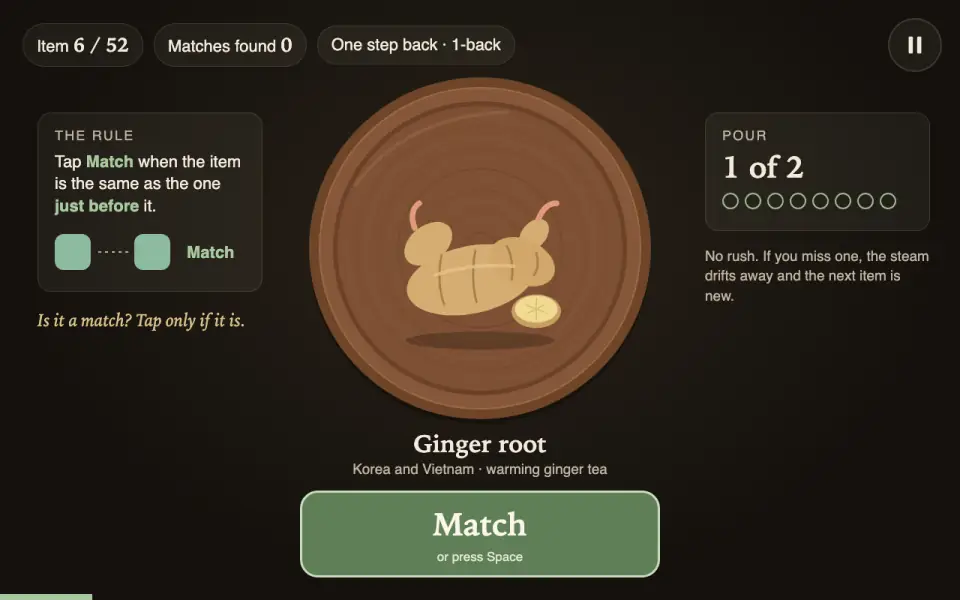
Tea Ceremony Sequence is an n-back exercise: tea utensils appear one at a time on a wooden tray, and players tap Match when an item repeats one or two steps back. The slow, ritual pace of tea keeps a demanding memory task calm and unhurried.
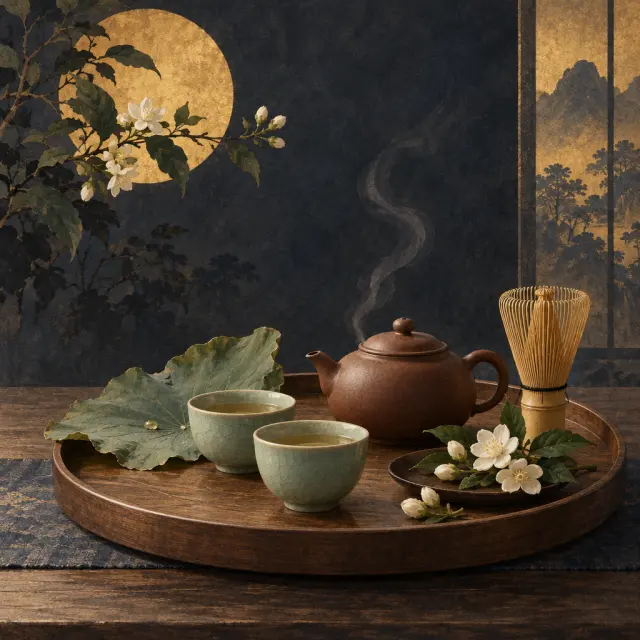
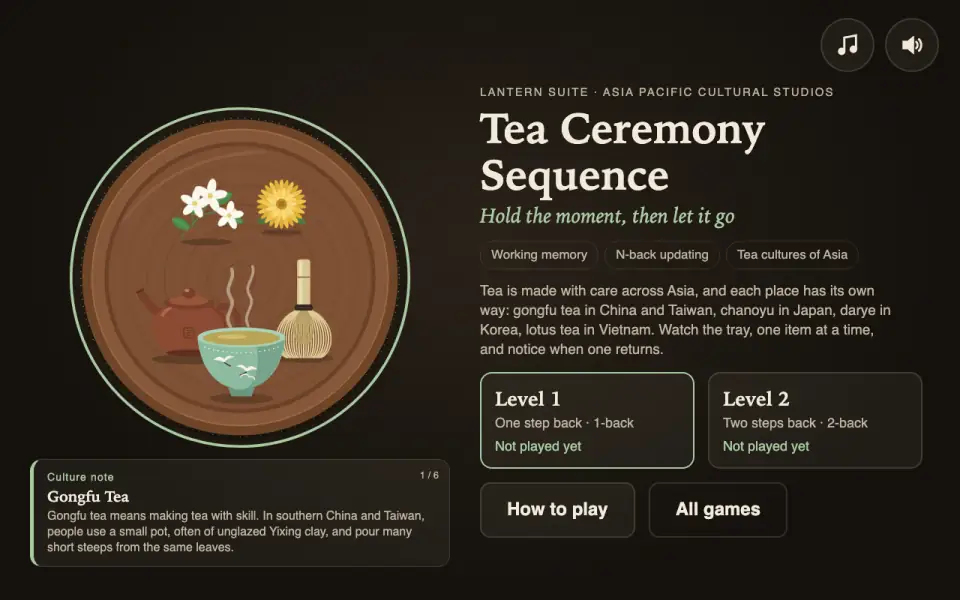
What players see
The science
Working-memory updating. Updating what you hold in mind helps with multi-step instructions, keeping track in a conversation, and remembering what comes next in a work routine.
Kirchner's task asks whether each item matches one shown steps earlier, which requires constantly updating memory. It is the basis of today's n-back.
Kirchner, 1958, "Age differences in short-term retention of rapidly changing information," Journal of Experimental PsychologyA meta-analysis of 24 neuroimaging studies found n-back tasks consistently engage frontal and parietal brain regions linked to working memory.
Owen, McMillan, Laird & Bullmore, 2005, "N-back working memory paradigm: a meta-analysis," Human Brain MappingN-back training transfers mainly to other n-back tasks, with very small effects beyond, so this game is offered as near-transfer practice.
Soveri, Antfolk, Karlsson, Salo & Laine, 2017, "Working memory training revisited," Psychonomic Bulletin & Review
Culture players carry with them
Players meet tea traditions from five places: gongfu tea in China and Taiwan, Japanese chanoyu, Korean darye, Vietnamese lotus tea and Taiwanese mountain oolong. Each utensil on the tray carries a short note naming its home.
- Gongfu TeaGongfu tea means making tea with skill. In southern China and Taiwan, people use a small pot, often of unglazed Yixing clay, and pour many short steeps from the same leaves.
- The Way of TeaIn Japan's chanoyu, the host whisks powdered green tea, called matcha, with a bamboo whisk. Tea master Sen no Rikyū, who lived in the 1500s, is remembered for teaching harmony, respect, purity and calm.
- Korean DaryeIn Korea, darye means the manners of tea. Green tea grows on hillsides in Boseong and Hadong. In 2017, a United Nations farming agency honored Hadong's traditional way of growing tea.
Culture notes as they appear in the game, between levels and on the title screen.
Impact
For the people who play
Calm, ritual pacing models patience and lets players practice focus without pressure.
Players see five distinct tea cultures, countering the idea of one generic Asian tradition.
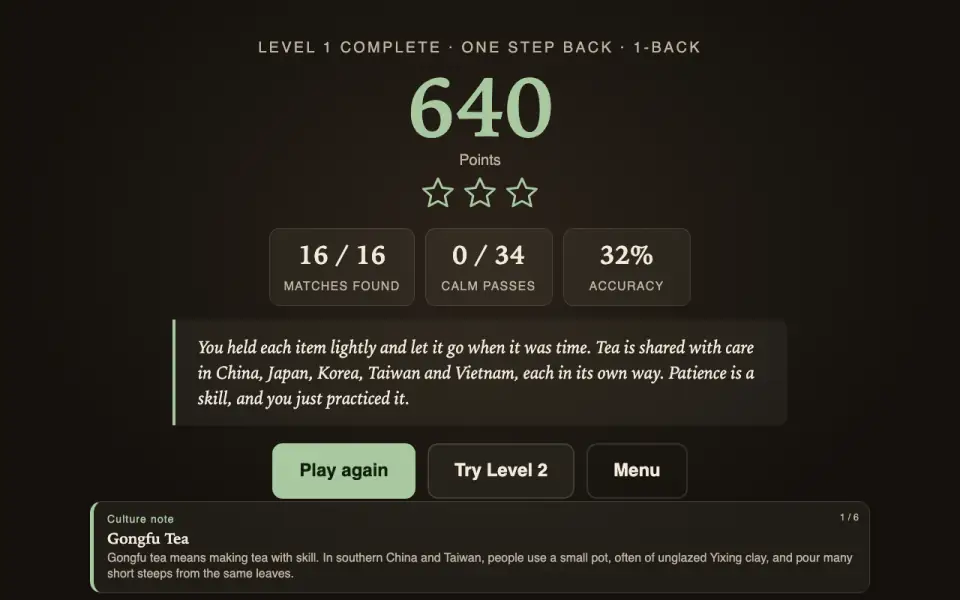
Clear counts of matches and calm passes show progress within the task.
For your agency
Culturally responsive programming for Chinese, Japanese, Korean, Taiwanese and Vietnamese heritage populations
Working-memory practice suited to self-directed use between scheduled programs
No network connections: one offline file, no accounts, and no data leaves the tablet
The Lantern Suite offers structured practice and cultural learning. It is not a medical device or a treatment. See our claims and evidence policy.
Pilot Tea Ceremony Sequence with your program
Every game is one offline file, ready for your publication and security review.